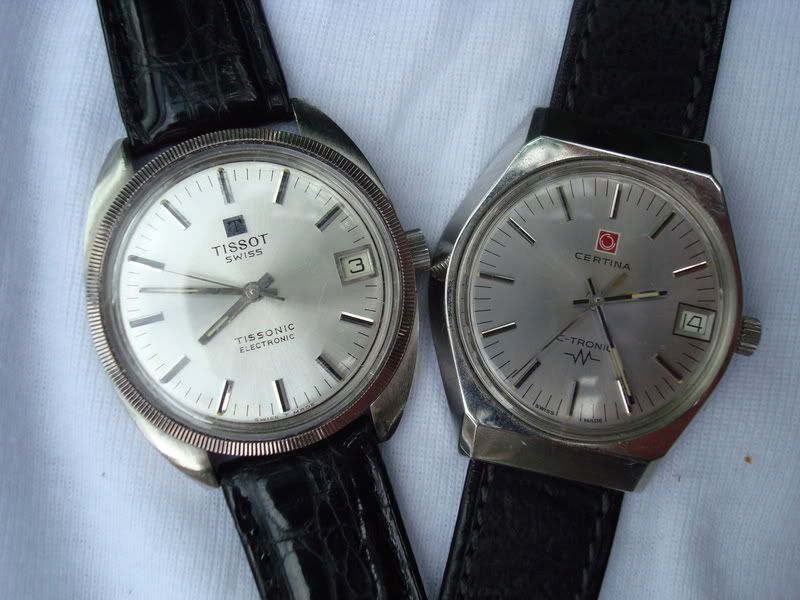
Weer ouwe meuk gekocht.
Ik vond het wel wat hebben: een stemvorkhorloge dat er van binnen veel mooier afgewerkt uitziet dan de gewone Accutrons.
Zag er een te koop, kon me weer niet inhouden en nu krijgt mijn Accutron 214 dus straks gezelschap van een neefje.
Een volgens de verkoper nog ongedragen Certina met een werk er in als op deze foto:
[center] [/center]
En nu maar weer wachten op de pakjesman en dan komen er ook fotoos van de nieuwe ouwe.
Hieronder een verhaal over dit type uurwerk, de ESA-stemvork, die in diverse horlogemerken te vinden is/was en -zo las ik op een andere site- als de Rolls Royce der stemvorken werd beschouwd.
Mosaba, ESA
Mosaba means ‘montre sans balancier’ (‘watch without a balance wheel’).
It has a frequency of 300 Hz.
1966 Max Hetzel (who invented the Accutron) moves back from the USA to Switzerland. On May 1st 1966, he starts to work for the ESA at the ‘Laboratoire Suisse de Recherches Horlogère’ (LSRH) and at the ‘Centre électronique horlogère’ (CEH) to develop the Mosaba.
1967 CEH shows a prototype of the Swissonic 100 at the Basle Fair. Problems with Bulova-patents block commercial production.
1968 On November 11th 1968, the president of the Bulova Corporation signs a contract with ESA to agree on ESA’s use of the Bulova-Accutron patents.
1969 The first watches with the caliber ESA 9162 are sold.
1970 On October 26th, ESA asks Dubois Dépraz SA of Le Lieu, Switzerland, to secretively develop a chronograph mechanism for the ESA 9162 (patent no. 554016 Switzerland, inventor François Berthoud). The new caliber becomes the ESA 9210.
1972 At press conferences on May 11th, that take place simultaneously in Geneva, Hongkong and New York, the Swissonic 100 Chronograph, Mosaba cal. 9210 is presented. The world’s first electronic chronograph with a tuning fork becomes a fait accompli. The production of the chronograph is limited to 21.000 pieces.
1976 End of the production of the Mosaba.
1990 At the Basle Fair of 1990 Technos Neuchâtel Switzerland represents a limited series of the ‘Technos Mosaba’ with movements made out of old parts of the the ESA 9162.
The term tuning fork is not very apt for the resonator used in the Mosaba. It would be more accurate to speak of a deflection resonator with two metal counterpoises or of a ‘compensated’ tuning fork. The basic principles are equal to the Bulova-Accutron movement.
This caliber is sold by many companies under the most particular names:
the ‘Tronosonic’ of Beaume et Mercier (caliber 19162, 19164, 19210),
the ‘Certronic’ of Certina (cal.29.151, 29.152 and 59-351)
the ‘Mosaba’ of Derby,
the ‘Eternasonic’ of Eterna (cal.1550 740 and 1551 742),
the ‘Ultronic’ and ‘Titronic’ of Longines (cal.6312 and 6332),
the ‘XL-tronic’ of Movado and Zenith (cal.500 and 505),
the ‘Tissonic’ of Tissot (cal.2010 and 2020),
the ‘Electronic f300 Hz’ of Omega (cal.1250) in 1970,
the ‘Electrosonic’ of Rado (cal.740 and 742) etc.


 [/center]